Mar 14, 2026
The Hottest Startup Job Categories in NYC Right Now (2026)
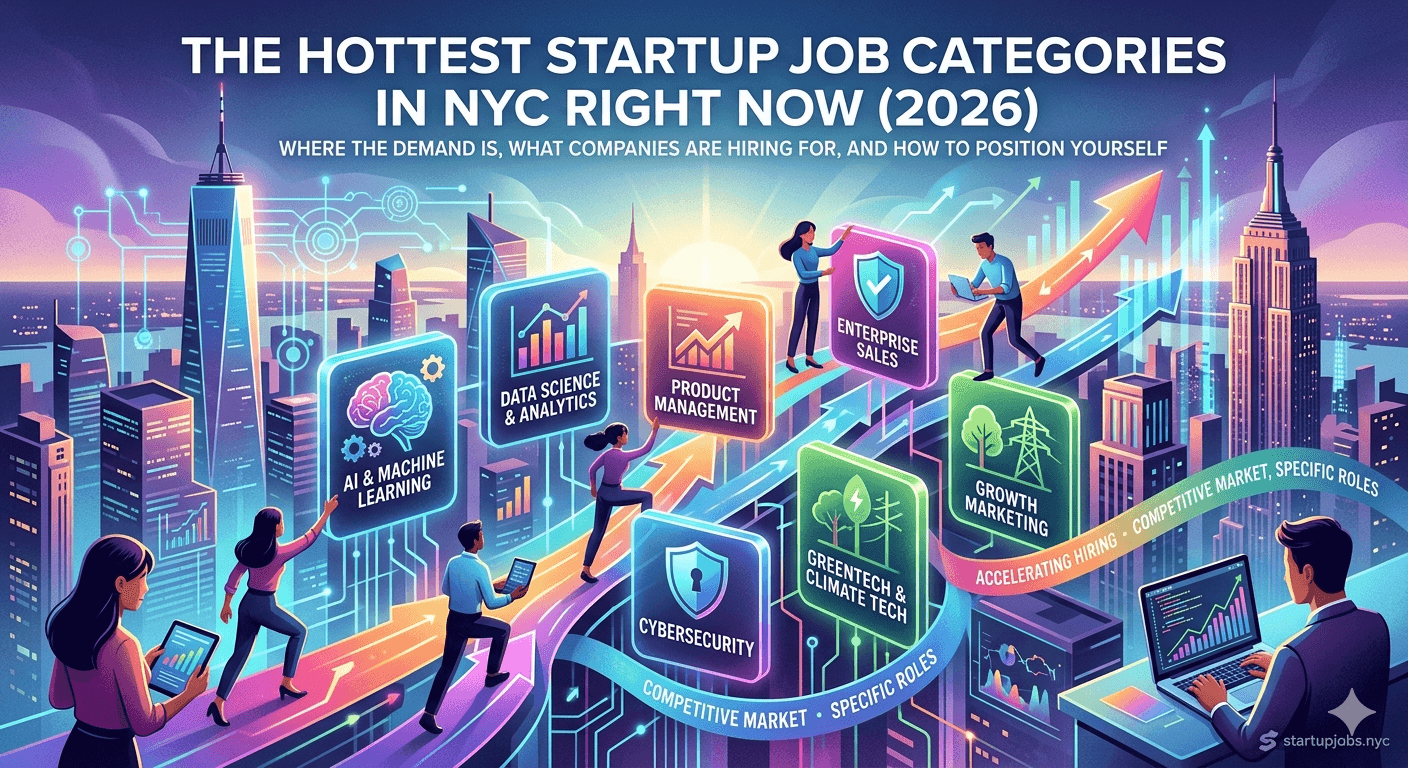
The Hottest Startup Job Categories in NYC Right Now (2026)
Where the demand is, what companies are hiring for, and how to position yourself to land the role.
If you're looking for a startup job in New York City in 2026, the good news is that hiring is accelerating. The bad news is that the competition is fierce, and the market has gotten more specific. Posting a generic resume to every open role isn't a strategy anymore. What works is knowing exactly which roles are in demand, why companies are hiring for them, and how to position yourself as the right candidate for this particular moment in the NYC tech ecosystem.
This is that guide.
We track hiring signals across hundreds of NYC startups — from seed-stage companies raising their first rounds to growth-stage companies expanding into enterprise. Here's what we're seeing in 2026.
→ Browse open NYC startup jobs at startupjobs.nyc
1. AI / Machine Learning Engineers
The fastest-growing technical role in NYC startups
If there is one role category that defines the 2026 NYC startup job market, it's this one. AI and ML engineers — including AI platform engineers, ML infrastructure engineers, AI data engineers, and AI consultants — are in extraordinary demand across virtually every sector of the ecosystem.
The specific roles vary by company stage and product type. Early-stage AI-native startups are hiring ML engineers who can build and iterate on models directly. Growth-stage SaaS and fintech companies are hiring AI platform engineers to embed AI capabilities into existing products. Larger companies are hiring AI strategists and consultants to help enterprise customers implement and adopt AI workflows.
The sectors driving the most demand: B2B SaaS, fintech, productivity tools, healthcare AI, and AI infrastructure. Companies like VAST Data, Runway, Rogo, and Profound are all scaling their AI and ML teams in 2026.
What to emphasize on your resume: Production ML experience (not just research), familiarity with LLM APIs and fine-tuning workflows, and any experience with ML infrastructure tooling (Ray, MLflow, Kubernetes for ML workloads). For AI platform roles, backend engineering chops matter just as much as model knowledge.
Recommended reading: Designing Machine Learning Systems by Chip Huyen. This is the book that practicing ML engineers at startups actually reference. It covers the full lifecycle of building production ML systems — data pipelines, feature engineering, model deployment, monitoring — with a pragmatic, startup-relevant lens. If you want to talk credibly about building ML in production during an interview, this is where to start.
Typical title variations: ML Engineer, AI Engineer, AI/ML Platform Engineer, Machine Learning Scientist, Applied AI Engineer, AI Data Engineer, AI Solutions Architect.
2. Full-Stack and Backend Software Engineers
The bedrock hire for every stage of startup
AI gets the headlines, but full-stack and backend engineers remain the most consistently in-demand technical role across NYC's startup ecosystem. At the seed and Series A stage, a startup's first five engineers are almost always building product — and full-stack engineers who can own the entire surface area of a feature are exactly what founders want.
At growth stage (Series B and beyond), the demand shifts toward specialization: backend engineers who can scale distributed systems, senior engineers who can lead platform architecture decisions, and staff engineers who can manage complexity across a large codebase.
The sectors hiring the most: B2B SaaS, fintech (Ramp, Vestwell, PactFi), healthtech (Grow Therapy, Talkiatry, Alaffia Health), and AI infrastructure. Almost every company on any given week's funding list is hiring engineers.
What to emphasize on your resume: The stack matters less than you think — what NYC startup hiring managers actually care about is shipping velocity, ownership mentality, and experience building features end-to-end. Production experience with TypeScript, Go, Python, or Rust all translate well. Show your GitHub.
Recommended reading: A Philosophy of Software Design by John Ousterhout. Where most engineering books teach you how to write code, this one teaches you how to think about complexity — which is the actual skill that separates senior engineers from everyone else. Startup engineering interviews increasingly test system design and architectural judgment, and this book sharpens both. Short, dense, and worth re-reading every year.
Typical title variations: Software Engineer (Full-Stack), Backend Engineer, Senior Software Engineer, Staff Engineer, Platform Engineer.
3. Product Managers
High demand, high bar — especially at senior level
Product managers are among the most sought-after non-engineering hires at NYC startups in 2026, but the demand is concentrated at the senior and staff level. Entry-level PM roles are rare at startups — most early-stage companies expect engineers or founders to cover product until they hit a level of scale that justifies a dedicated PM org.
Where the PM demand is highest: AI products (companies need PMs who understand what AI can and can't do and can translate that to roadmap decisions), B2B and enterprise SaaS (the GTM complexity of landing and expanding enterprise accounts requires disciplined PM leadership), and fintech and healthtech (where regulatory constraints and user experience tradeoffs require experienced product thinking).
Senior and staff PMs who have owned a product from 0-to-1 at a prior startup — and can show user growth, revenue impact, or retention improvements as a result — are the most in-demand profiles in this category.
What to emphasize on your resume: Outcomes, not activities. Don't tell a hiring manager what features you shipped — tell them what happened after you shipped them. ARR impact, activation rate improvements, retention gains. Quantify everything.
Recommended reading: The Startup Product Manager by Manan Modi. Most PM interview prep resources are written for Google and Meta — they'll teach you the CIRCLES method and how to prioritize a backlog at a company with 500 PMs. That's not the job. This book is written specifically for the startup context, where PMs wear many hats, roadmaps shift weekly, and the ability to move fast without breaking everything is the actual skill being evaluated. Read it before you apply anywhere.
Typical title variations: Product Manager, Senior PM, Staff PM, Group PM, Head of Product, VP of Product (at Series B+).
4. Sales and Go-to-Market Roles
Revenue efficiency is the mandate — these roles are the engine
As the startup funding environment has matured, investors are demanding more revenue efficiency. That shift has made GTM talent — particularly people who can close enterprise deals and build repeatable sales motions — some of the most valuable hires in the ecosystem.
The specific roles in demand: Account Executives (especially those with experience selling to mid-market and enterprise), SDRs and BDRs for pipeline generation, GTM leads who can build the function from scratch, and demand generation specialists who can operate paid acquisition at scale.
The sectors with the most open sales roles: B2B SaaS (nearly every growth-stage company is building out its sales team), fintech (Ramp, Vestwell, Sigma 360), healthcare SaaS (Moxie, Alaffia Health), and AI platforms (Rogo, Profound). Sales talent that has sold into financial services, health systems, or enterprise technology buyers commands a significant premium.
What to emphasize on your resume: Your quota attainment (with numbers), average ACV or deal size, the specific buyer personas you've sold to, and your ramp time at prior companies. NYC startup sales hiring managers are looking for signals that you've done it before and can do it again.
Recommended reading: From Impossible to Inevitable by Aaron Ross and Jason Lemkin. This is the canonical playbook for building repeatable B2B revenue at a startup — covering outbound sales development, specialization of sales roles, and how to think about scaling a GTM function from nothing. If you're an AE or SDR trying to understand how the best startup sales organizations are built (and how to talk about it in an interview), this is the book.
Typical title variations: Account Executive, Enterprise AE, Mid-Market AE, SDR, BDR, Sales Development Rep, GTM Lead, Head of Sales, VP of Sales (at Series B+).
5. Customer Success and Solutions Engineering
The revenue retention and expansion layer
As NYC startups have matured into enterprise sales motions, the post-sale function has become critical. Customer success managers (CSMs), solutions engineers, and technical account managers are in consistent demand — particularly at SaaS and AI platform companies where land-and-expand is the growth model.
Solutions engineers occupy a particularly high-value niche: they sit between sales and product, helping prospects and customers understand how to integrate and deploy software. At AI platform companies, this role is especially important because customers often need significant technical guidance to get value from the product.
The sectors hiring most for these roles: AI SaaS, fintech infrastructure, healthtech platforms, and any B2B SaaS company past Series B that is actively scaling its enterprise customer base.
What to emphasize on your resume: Retention metrics (NRR, GRR), expansion revenue you've driven, and any technical depth you can bring to the customer relationship. For solutions engineering specifically, demonstrate that you can both code and present — that combination is rare and valuable.
Recommended reading: Customer Success by Nick Mehta, Dan Steinman, and Lincoln Murphy. The definitive book on building and scaling a customer success function at a SaaS company. It covers how to structure CS teams, how to measure health scores and churn risk, and how to build the playbooks that turn a good CS rep into a great one. Foundational reading for anyone in or entering the CS profession.
Typical title variations: Customer Success Manager, Senior CSM, Technical Account Manager, Solutions Engineer, Solutions Architect, Implementation Manager, Director of Customer Success.
6. Marketing Roles
B2B storytelling, pipeline generation, and brand building
Marketing at NYC startups in 2026 looks quite different from marketing at consumer companies or large enterprises. The demand is concentrated in three areas: product marketing (helping sales understand and articulate the product, building competitive positioning, enabling GTM), growth and performance marketing (running paid acquisition at efficient CAC), and content and brand (increasingly important for AI-era discoverability — ranking in Google and surfacing in AI search tools like Perplexity and ChatGPT).
The sectors with the most marketing demand: B2B SaaS, AI products, healthtech, and fintech. Product marketers who have worked at a high-growth SaaS company and can produce battle cards, competitive analyses, and sales enablement materials are particularly valuable. Growth marketers who understand SEO, paid social, and product-led growth are in demand across nearly every sector.
What to emphasize on your resume: Pipeline contribution and CAC/LTV metrics for growth roles; win rate improvement and deal velocity for product marketing roles; organic traffic and MQL volume for content and SEO roles.
Recommended reading: Positioning: The Battle for Your Mind by Al Ries and Jack Trout. Published decades ago and still the most practically useful book on marketing strategy available. Every product marketer at a startup will eventually face the question of how to position a new product in a crowded market — and this book is the clearest framework for thinking through that problem. Short, readable, and immediately applicable to the messaging work that startup marketers do every day.
Typical title variations: Product Marketing Manager, Growth Marketer, Performance Marketing Manager, Demand Generation Manager, Content Marketing Manager, Head of Marketing.
7. Data Roles
Analytics, BI, and data science powering product and revenue decisions
NYC startups are generating more data than ever — and the ability to turn that data into decisions is increasingly a competitive differentiator. Data scientists, analytics engineers, and BI analysts are in consistent demand across AI products, fintech, and healthtech, where data quality and insight velocity directly impact both product and revenue.
Analytics engineers (who sit between data engineering and business analysis, typically working in dbt and Snowflake or BigQuery) are among the most in-demand data profiles in the ecosystem right now. They build the models that transform raw event data into business-legible metrics — and they're increasingly critical as companies mature past Series B and need reporting infrastructure.
Data scientists with ML chops are also in demand at AI product companies, where building and evaluating models overlaps with the data science function.
What to emphasize on your resume: The tools you know (dbt, Snowflake, Looker, Python, SQL), the decisions you've influenced with data, and any experience building pipelines or dashboards that are used daily by non-technical stakeholders.
Recommended reading: Storytelling with Data by Cole Nussbaumer Knaflic. The most important skill a data analyst or scientist can develop — beyond the technical work — is the ability to communicate findings clearly to non-technical decision makers. This book teaches exactly that: how to choose the right chart, eliminate visual clutter, and build a narrative around data that actually changes decisions. Every data professional at a startup should read it early.
Typical title variations: Data Scientist, Analytics Engineer, BI Analyst, Data Analyst, Senior Data Scientist, Head of Data, ML Data Engineer.
8. Operations and Strategy
The operational backbone of early-stage NYC startups
At the seed and Series A stage, operational talent — people who can run a function, manage a process, or own a strategic initiative without much direction — is enormously valuable. Operations leads, chiefs of staff, and strategy roles are common at early-stage companies where the founders are too stretched to manage every workstream themselves.
In the broader NYC ecosystem, there's also a consistent pipeline of roles at venture capital firms and startup studios: VC analysts, investor relations associates, and platform roles that sit at the intersection of investing and operations.
Chiefs of staff in particular are one of the highest-leverage hires a founder can make at the Series A or B stage — and candidates with prior startup operations experience or management consulting backgrounds are the most competitive.
What to emphasize on your resume: The breadth of what you've owned, your comfort with ambiguity and rapid context-switching, and any evidence of taking a messy problem and making it structured. Specific results matter here too — cost savings, process improvements, time-to-hire reductions, revenue operations improvements.
Recommended reading: High Output Management by Andy Grove. The foundational text for anyone who wants to understand how to manage people, processes, and output at a fast-moving company. Grove wrote it as Intel's CEO and it remains — 40 years later — the most cited book among startup operators, chiefs of staff, and early employees trying to figure out how to have leverage in a rapidly growing organization. Dense with frameworks that are immediately useful in a startup context.
Typical title variations: Chief of Staff, Operations Lead, Head of Operations, Strategy & Operations Manager, Startup Operations Manager, VC Analyst, Platform Associate.
How to Use This Guide
The most common mistake NYC startup job seekers make is applying to roles they're technically qualified for without understanding the specific context a company is hiring for. A backend engineer role at a Series A AI startup is a completely different job than a backend engineer role at a Series C fintech — different expectations, different stack, different culture, and different growth trajectory.
Use this guide to identify which category matches your background, then research the specific companies in that category that are hiring right now. Look at their recent funding rounds, read their job descriptions carefully, and tailor your outreach to the specific moment the company is in.
That's how people land startup jobs in NYC in 2026.
→ Browse all open NYC startup jobs, updated daily, at startupjobs.nyc
Quick Reference: NYC Startup Job Categories at a Glance
Role Category | Demand Level | Best Sectors | Recommended Book |
|---|---|---|---|
AI / ML Engineer | 🔥🔥🔥 Very High | AI infra, SaaS, fintech | Designing Machine Learning Systems — Chip Huyen |
Full-Stack / Backend SWE | 🔥🔥🔥 Very High | All sectors | A Philosophy of Software Design — John Ousterhout |
Product Manager | 🔥🔥 High | AI products, B2B SaaS, fintech | The Startup Product Manager — Manan Modi |
Sales / GTM | 🔥🔥🔥 Very High | SaaS, fintech, healthtech | From Impossible to Inevitable — Ross & Lemkin |
Customer Success / Solutions Eng | 🔥🔥 High | AI SaaS, fintech infra | Customer Success — Mehta, Steinman & Murphy |
Marketing | 🔥🔥 High | B2B SaaS, AI, healthtech | Positioning — Al Ries & Jack Trout |
Data | 🔥🔥 High | Fintech, AI products | Storytelling with Data — Cole Nussbaumer Knaflic |
Ops & Strategy | 🔥 Moderate-High | Early-stage, VC | High Output Management — Andy Grove |
Published March 2026. Updated regularly. Data sourced from active NYC startup job listings and venture funding activity.